Daystar Selorm Atti; Prince Hagan
2024
“7th December 2024” has become the buzzword for every eligible voter in Ghana today. The day represents either a continuity or a change in the government’s political phase as Ghanaians march to the polling station to vote for a new president. Ghana, a country in West Africa with a population of 33.6 million (MacroTrends) and an annual economic growth rate of 6.9% in Q2 in 2024 (Trading Economics, 2024), covers a total land area of 238,533 square kilometres, making it 82nd largest country in the world by area (Ghana Statistics). With 16 administrative regions, Accra, located along the Gulf of Guinea, serves as the capital city.
As Ghana prepares for another pivotal election on December 7, 2024, the spotlight turns to one of the most pressing economic challenges: the sharp depreciation of the Ghanaian cedi. With a staggering exchange rate mean of 14.37 GHS/USD —three times higher than in 2020—the nation’s currency volatility has raised concerns about the underlying economic and political factors contributing to this trend. We focus our attention on the Ghana Cedi against the US Dollar during election years from 2008-2024 (CEICData.com)
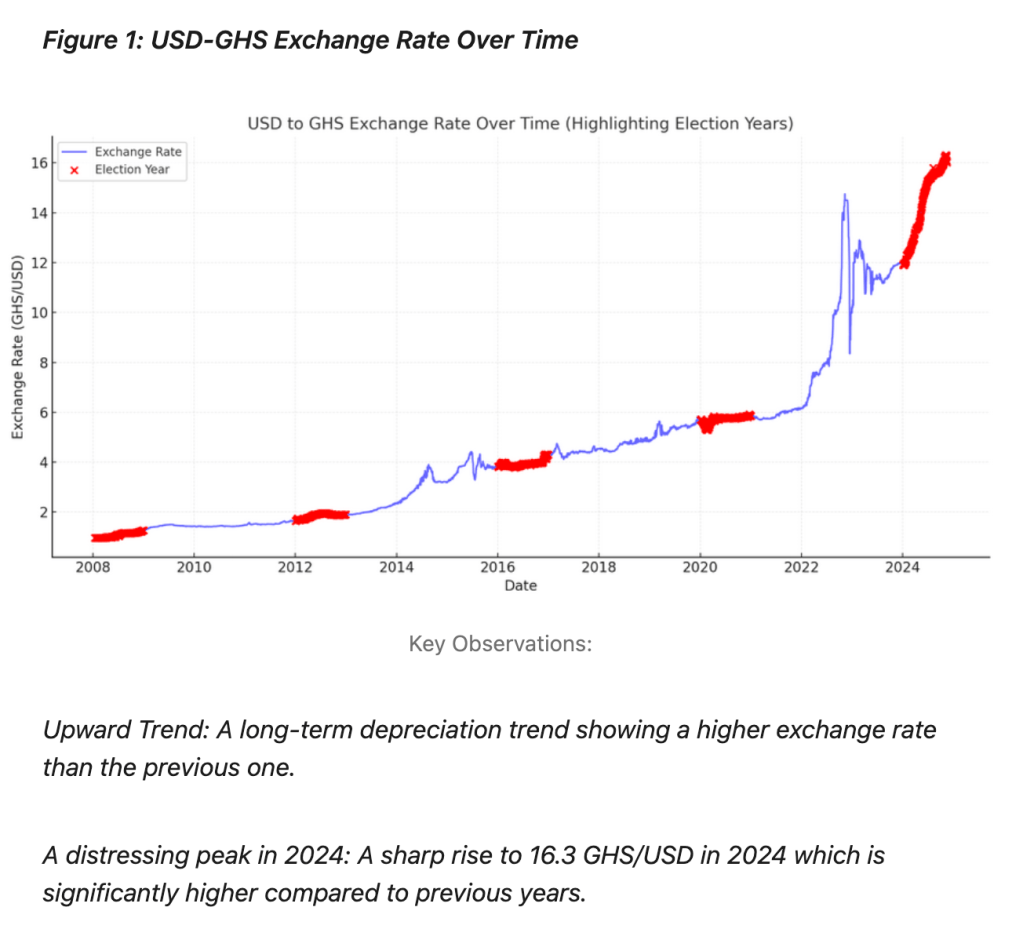
Election Year vs Exchange Rates
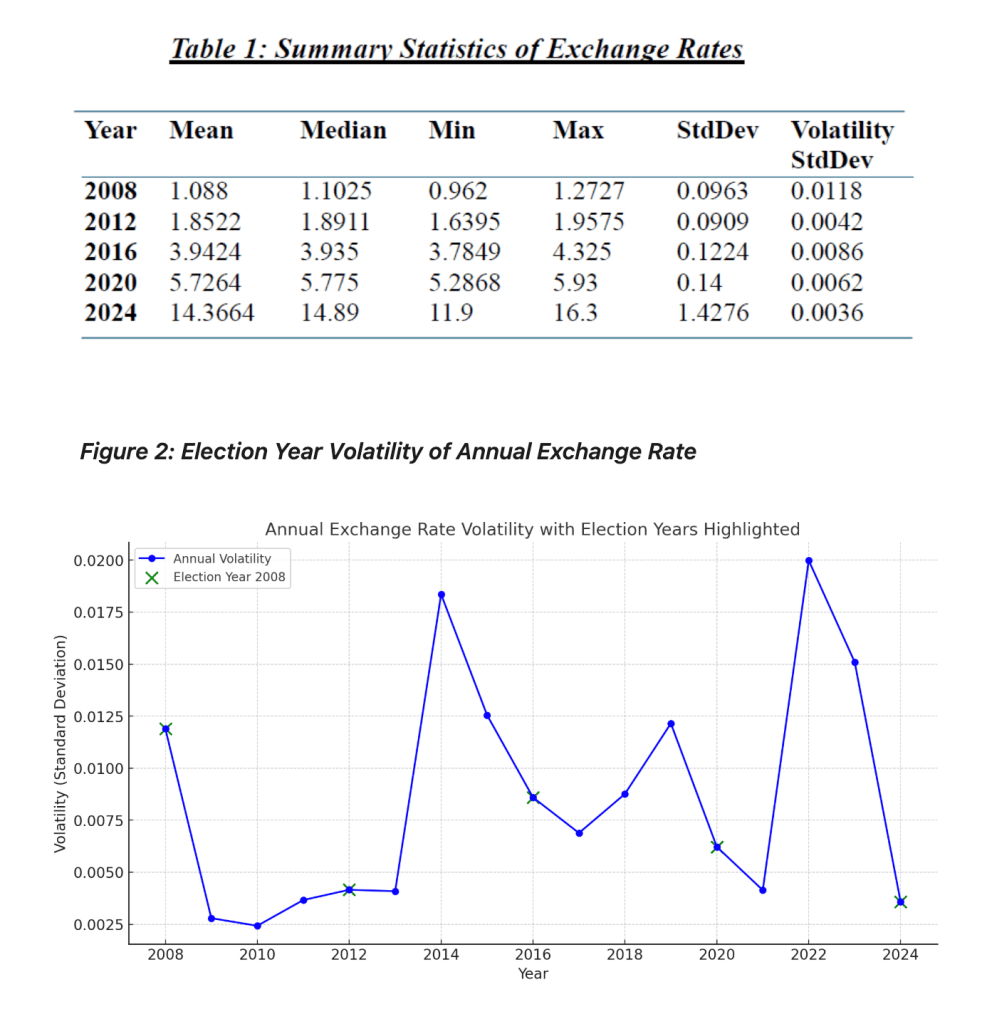
The 2008-2024 analysis of Ghana’s exchange rate data shows a troubling pattern. The Cedi’s behaviour of losing value against the US dollar is consistent throughout these selected election years. The trend can be associated with peaks in uncertainty and speculation, reaching its apex in 2024 with a historical rate mean of 14.37 GHS/USD. From the data, the increasing volatility was reflected in the rising standard deviation from table one, which soared to 1.43 in 2024, which is evidence of heightened instability. The dynamics of an election year are associated with numerous variables, especially economic disruptions, which can be attributed to heightened government spending, political uncertainty, and market speculation (Zubairu et al., 2024; Awadzie et al., 2024). An increase in government spending and heightened political uncertainty are typically associated with election years, with 2024 facing the same scenario. The government’s projected budget deficit of 5.9% from 4.6% in 2023 has also increased inflationary pressures (UDS SOB DoF, 2023).
Structural weaknesses, including a heavy reliance on imports (35% of GDP in 2023) and limited foreign exchange reserves, have compounded the currency’s decline. Ghana’s dependence on imports, valued at $26.73 billion in 2023 (Ghana Imports, 2023), leaves the economy vulnerable to external shocks and currency depreciation. Coupled with policy uncertainty and differing strategies proposed by the two main political parties—NPP and NDC—the economic environment becomes even more volatile. While the NPP emphasizes building a digital economy, the NDC’s focus on industrialization introduces additional uncertainties regarding fiscal policy.
The two major political parties, i.e. NPP and NDC, propose an ambitious reform in the 2024 manifestos that will be going to the polls on December 7, from advancing digital finance to boosting industrialization. Nonetheless, these strategies are not immediate concerns for cedi stability; they may take time to bear fruit, which creates concerns about exchange rate stability. As Ghana draws near election day, the omission of a clear and immediate solution to the country’s currency depreciation underscores the urgent need for fiscal discipline and investor confidence restoration.
The distressing peak of the 2024 exchange rate should be a startling reminder of the interplay between political decisions and economic stability. Finding the right tune for Ghana’s currency depreciation will require a robust policy measure, including but not limited to reducing fiscal deficits, diversifying exports, and rebuilding foreign reserves. As citizens head to the polls, the implications extend beyond party and tribal politics; the results and expectations are based on the foundation of economic stability and quality of life.
As the December 7 elections approach, the government and political parties must prioritize transparency and sustainable economic policies to mitigate the adverse effects of currency volatility. The Cedi’s story is not just a tale of numbers; it reflects the realities faced by every Ghanaian navigating the challenges of rising costs and economic uncertainty.

